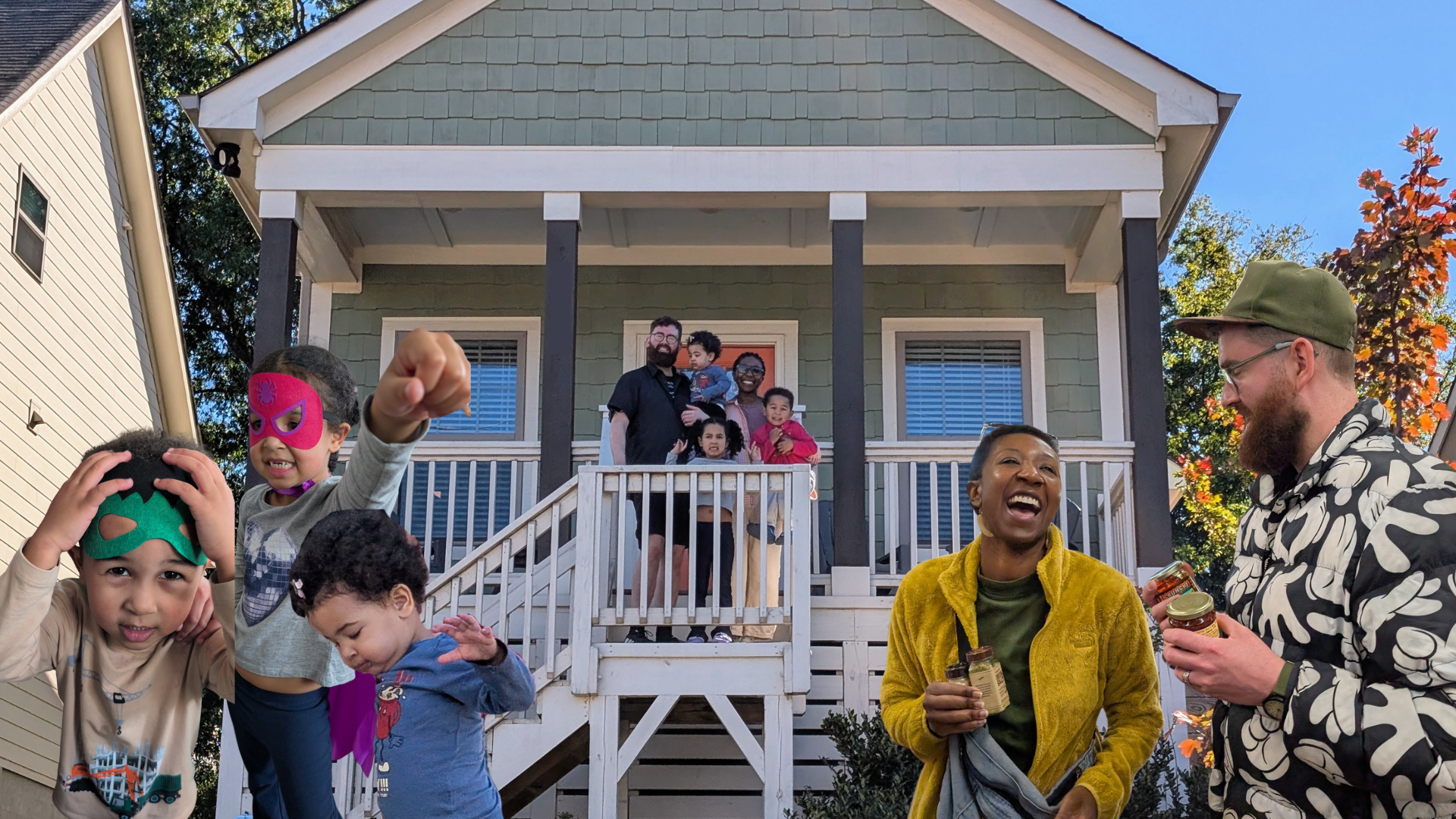
My sister, Ericka, and her husband, Stefan Byrne, have moved to the Grant Street Community with their three children, Maeve, Otis, and Penelope!

Erin Dooley is the co-founder of BLK South and Neighborhood Chaplain in Durham, NC. With over twenty years in nonprofit leadership, pastoral ministry, and strategic communications, she has led numerous faith-based and community initiatives. A Master of Community Leadership graduate at Eden Theological Seminary, Erin’s work explores the intersection of theology, human behavior, and social change—creating spaces of healing and belonging for historically marginalized communities. Learn More
“The children are always ours, every single one of them, all over the place, and I don't care what they come from, what their ancestors were — there is no such thing as other people's children. And when you come to know it, you will see it is true.” — James Baldwin
There are children on Grant Street again.
We were told they hadn’t had young children living on the street since Miss Pam was a little girl. And by living, I think they mean children who were actively engaged in the everyday life of the neighborhood. Miss Pam, now in her sixties, is one of the beloved Grant Street Ladies who have spent much of their lives loving, protecting, and preserving this neighborhood.
I have been sitting with what it means to have children on Grant Street again. Not just children living in houses, but children becoming part of a story that began long before they arrived.
What does it mean for children to grow up knowing the names of the elders who came before them? To recognize their faces, hear their stories, receive their hugs, and understand that they belong to something much bigger than themselves?
Over the past few days, I have watched Maeve, Otis, and Penelope light up as they meet Miss Dianne, Miss Brenda, Miss Pam, and Miss Vivian. I've watched them embrace these women with the kind of affection that reminds us how naturally children can enter into relationships when given the opportunity.
I've watched Maeve look for Bishop Laney, the pastor of Monument of Faith Church, and insist that he was the fifth “Grant Street Lady” she simply had to meet.
I've watched her sit in a historic Black church on a Sunday morning, clapping along to old hymns, listening to the music that carried generations of Black people through suffering, struggle, and survival. Songs that sustained our ancestors through circumstances we can scarcely imagine, yet whose words still shape how we understand faith, freedom, and community today.
And I’ve watched her listen as Bishop Laney weaves the history of enslavement, the witness of Scripture, and the theological imagination of the Black church into a compelling vision for how we are called to live today. I can only imagine how much there is for her young mind to take in as a biracial child of Irish and Black American heritage who has spent the last three years growing up in Ireland.
I wonder what all of this is doing in her.
What is being formed in these children as they encounter a living history that is not confined to textbooks, museums, or annual celebrations, but embodied in the people who greet them on the sidewalk, welcome them into church, and call them by name?
I am beginning to understand more deeply just how extraordinary it is for a neighborhood to hold multiple generations of people who know one another, care for one another, and look after one another.
Because when generations live alongside one another, the legacy of our elders has somewhere to go.
Their stories have someone to receive them. Their wisdom has lives in which to take root. Their memories have people who can carry them forward.
And perhaps most importantly, the next generation has an opportunity to understand itself as part of a story that did not begin with them.
There is something profoundly different about moving to a place without knowing its history and intentionally moving somewhere with a desire to understand the story into which you are being engrafted.
The former allows us to occupy a place. The latter invites us to belong to it.
When Kendall and I moved to the Grant Street Community, we knew we wanted to become part of this neighborhood's story. We knew there was something sacred about returning to a place where his own family had roots, and where generations of Black families had built lives, nurtured institutions, and sustained one another through extraordinary change.
What I could not have imagined was that, less than two years later, my sister and her entire family would be living here, too.
And yet, here we are.
It has been a long and difficult journey to get them here. One filled with uncertainty, obstacles, and moments when I wasn't sure how everything would come together.
But they are here.
And I don't think we fully understand yet what that means.
The psychological, theological, emotional, and relational implications of this moment will likely reveal themselves over time.
Reflection Questions:
Who are the elders in your life whose stories and wisdom have shaped who you are today?
How can we create communities where children and elders know, care for, and learn from one another?
RECOMMENDED READING